Education hub
Credit Score
Understand how UK credit scores and credit reports work, what affects your credit profile and practical steps you can take to strengthen it.
Explore guides on credit reports, eligibility checks, CCJs, defaults, affordability and improving your score.
New to credit scores?
Start here
Three clear entry points before you dive into the full guide library.
Check your score
Learn how to check your credit score and understand what the number means.
Free Credit Score CheckUnderstand your report
See what information appears on your credit report and how lenders may use it.
Understanding Credit ReportsImprove your profile
Explore practical steps that may help strengthen your credit profile over time.
Improve Your Credit ScoreCredit score basics
How UK credit scores work
There is no single official UK credit score. Experian, Equifax and TransUnion use different scoring systems, and lenders may use credit-reference data alongside their own affordability and risk assessments.
- Different agencies may show different scores
- Lenders do not all use the same scoring model
- Your visible score is only part of a lending decision
Guides
Improve your credit
Practical guides on habits and file details that may support a stronger credit profile over time.

Guides
Understand your credit file
Learn what appears on UK credit reports and how negative markers are typically recorded.

Guides
Credit searches and lending
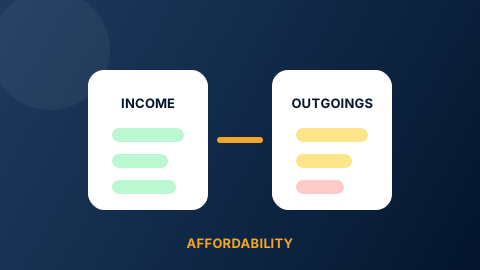
Understand soft and hard searches, and how lenders may assess affordability alongside credit data.
Your credit profile
What can affect your credit profile?
Lenders look beyond a single consumer-facing score.
Payment history
Missed or late payments may negatively affect your credit profile.
Credit utilisation
Using a large proportion of available revolving credit may affect lender assessments.
Existing borrowing
Current loans, cards and other credit commitments may influence affordability.
Electoral roll
Being registered at your current address can help lenders verify your identity.
Recent applications
Several hard credit applications in a short period can affect how lenders assess you.
Account history
Older, well-managed accounts can provide a longer record of borrowing behaviour.
Defaults and CCJs
Serious negative credit events can remain visible on your credit file for several years.
Financial associations
Joint financial products can create financial associations with another person.
Different lenders may weigh these factors differently.
Check your credit
Where can you check your credit information?
Start with educational guidance, then use official agency routes where you want to access your own file.
Experian
Understand how Experian credit scores and reports work.
Visit Experian(opens in a new tab)
External link to Experian
Equifax
Learn how to access Equifax credit information.
Visit Equifax(opens in a new tab)
External link to Equifax
TransUnion
Learn how TransUnion credit reports and partner score services work.
Visit TransUnion(opens in a new tab)
External link to TransUnion
Myths & facts
Common credit score myths
Balanced facts to keep expectations realistic.
Myth: Checking my own credit score lowers it.
Fact: Checking your own score generally uses a soft search and does not normally affect your score.
Myth: A high score guarantees approval.
Fact: Lenders also assess affordability, income, existing commitments and their own criteria.
Myth: There is one official UK credit score.
Fact: Experian, Equifax and TransUnion use different scoring systems.
Myth: Being declined permanently damages my credit score.
Fact: The decline itself is not normally recorded, although a hard credit search may appear on your file.
FAQs
Common questions about credit scores
UK-focused answers — not personalised credit advice.
Our editorial approach
How we create our credit score guides
- UK-focused editorial research
- Information checked against credit-reference agency guidance
- Regulatory and consumer guidance considered
- Content reviewed regularly
- Commercial relationships do not determine editorial guidance
Last reviewed: 16 September 2026
Sources last checked: 16 September 2026
Sources and further information
Reference links only — these organisations do not endorse WiT Money.
Found something that needs updating? Email contact@witfinancegroup.com. We review reported inaccuracies and update verified information promptly.
Related
Continue exploring
Connected credit-score and borrowing journeys.
Free Credit Score Check
How free UK checks and soft searches work.
ViewCredit Reports
What appears on your file and why it matters.
ViewEligibility Checkers
Soft-search tools before a full application.
ViewHow Credit Checks Work
Soft vs hard searches and what lenders may consider.
ViewCredit Builder Credit Cards
Cards that may help build credit when used responsibly.
ViewBad Credit Loans
Compare options if your credit history is limited or mixed.
ViewPersonal Loans
Compare personal borrowing once you understand your profile.
ViewRelated
Continue with a related page
Links are chosen from this category’s registry — not a generic keyword dump.